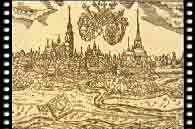
Fred's hometown Pilsen, Bohemia (now the Czech Republic)
Jewish Presence:
since 14th century Pre-Holocaust Jewish population: approximately 3,000
Fate of Jews during WW II: deported to the death camps
Post-war: the community numbered 293 in 1948
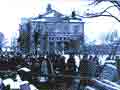
The Great Synagogue, which incorporates styles ranging from Moorish to Art Nouveau, was built in 1892, when Pilsen was home to about 5,000 Jews. The original design for the building, which called for a 65-meter tower, was rejected by Pilsen's town council on the grounds that it would compete with the mighty 100-meter-plus tower of St. Bartholomew's Cathedral for dominance of the city's skyline. A subsequent design by Rudolf Jan Stech greatly reduced the height of the building, resulting in the current red-and-cream structure, with its pair of 45-meter towers topped by gold Stars of David. Though only a tiny percentage of Pilsen's Jewish community survived the war, the Nazis were unable to destroy the Great Synagogue, since it is firmly anchored to buildings on either side. Instead, the German occupiers used the synagogue as a munitions warehouse, a tailor shop, and even an auction hall for the stolen possessions of deported Jews. As George Patton's army advanced on Pilsen in the waning days of the war, Nazi snipers took to the towers of the synagogue, making the building a target for American gunners.
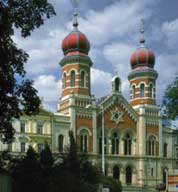 The Great Synagogue in Pilsen, 2nd
largest in Europe
The Great Synagogue in Pilsen, 2nd
largest in Europe
In turn-of-the-century Prague and also Pilsen, one of the major social issues of the time was the dichotomy between Czech and German culture. The Jews, who in the Czech lands had traditionally had a strong affiliation with German culture, were torn on the issue, and this division fostered strong anti-Semitic feelings among the Czechs.
 |
 |
 |
 |
 |
|
Transport from
Pilsen to Terezin
|
||||
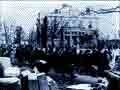
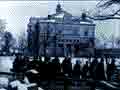
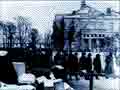
Deportation of the Jews from Pilsen; Bohemia-Moravia in which Fred and his mother were forced to leave their home.
Between 1941-1945, 122 trains transported 73,608 Jews from the Protectorate of Bohemia-Moravia to Theresienstadt. Most were sent to death camps; only 3,227 survived. Some 2,700 Jews lived in Pilsen before WWII. In 1938, they were joined by Jewish refugees escaping from the Sudetenland. In 1942, the Germans deported the whole community to death camps in Poland. Shown is a deportation operation at Pilsen.
After 1945, most of the non-Jewish Germans were exiled from Czechoslovakia; most of the Jewish Germans had died in the gas chambers. Then came Communism, which squashed any religious feeling left in the country. << back