<<< back to student roster
FAY WECHSLER
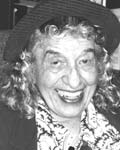
My Stories:
I was born January 12, 1912 in upstate New York, Gloversville, to an immigrant family of three brothers. My father had to peddle clothes and family goods and my mother took care of a small store. I lived a jam-packed life while working in my father's small department store and for a clothing buyer in New York City.
After marriage, I had a variety of jobs in stores, real estate, and offices, including a fourteen-year stint as a senior typist in New York Department of Mental Hygiene. When we moved to Phoenix, Arizona, I worked for Arizona State. There my husband passed away in August 1976 after thirty-nine years of marriage.
In order to help me with my grief I went back to college and graduated with a B.F.A. in 1986. I went to school for ten years and was the oldest to graduate that school, with a degree in Art at A.S.U. I have written many stories and plays through the years.
I wrote a book about my father's life, "Isaac's Odyssey." My daughter, Andrea Wechsler edited it and created a website where it can be read in its entirety at:
<<< back to top
In 1944, with my husband, Henry in 4F status, we considered starting a family. Seeking a larger apartment nearer Henry's job, we found a nice block with four brick apartment buildings. Two three-story buildings in the center had nice apartments within our means. Heat and hot water were included in the rent. Larger than ours, the apartments faced Lincoln Park and were closer to Henry's store and the Jewish merchants. After awaiting a vacancy, we rented a one-bedroom, first-floor apartment at 90 Morton Avenue.
Even before moving, we knew people there and happily acquired warm, friendly neighbors, including nice Jewish families. We liked Albany even more after moving. It was like one big happy family with the women helping and sharing great recipes, like gefilte fish, cheese blintzes, potato pancakes, kugel, split pea soup, roasts, and chicken dishes. The women taught me Mah Jong. Henry and I socialized regularly, including bridge with other couples as often as possible.
After Northville we appreciated friends even more. Henry had worked hard at Friedman's for a few years without a raise in his $25 weekly salary. For the month before Christmas, Henry had to work from 9 to 9 seven days a week without extra pay. After receiving only a $5 Christmas bonus, Henry job-hunted.
"Congratulate me, honey! I have landed a job with the Army and Navy Store. I will earn more money for fewer hours of work," Henry beamed. I hugged him, proud that he had found a better opportunity. The Army and Navy Store, on South Pearl closer to State Street where stores had better merchandise, carried men's clothing, including army rejects popular during wartime. The partners were Kopp and Friedman. We went out to celebrate Henry's job, feeling on top of the world.
The only sad thing was not being pregnant after trying and praying for over a year. After doctors said that Henry passed his sperm count test and I had no medical problems, Dr. Archibald, my gynecologist and also an obstetrician, suggested a special douche. A few months later in June 1944, we celebrated my pregnancy!
After hearing about the loss of my full-term baby, Dr. Archibald provided a special diet, cautioning me not to gain more than twenty pounds. Lucky to escape morning sickness, I felt pretty good and took extra good care of myself. Henry helped as much as possible. Everybody in the apartment buildings was happy for us.
Helen Silverman expected her first child a month later. At my six-month checkup, the doctor examined me on the table, pushing and twisting my abdomen. "What's the matter?" I asked anxiously. "Is everything all right?" Smiling, the doctor said, "The baby was in a breech position, but I twisted him or her around to correct the position."
Thankful for such a good doctor who did this in the office, I hoped for an easy and successful delivery. Though I looked quite big, I gained only seventeen pounds, mainly the baby and fluid. Henry's family was excited about our upcoming blessed event. Lil, Ben, and Harvey visited, followed by Rose and Harry. They liked our new apartment and the park.
On these fun visits, we introduced them to friends and showed them Henry's store. Labor pains began Friday, January 5th. At Albany Hospital, the doctor, thinking I had false labor, almost sent me home before the strong pains started. The hospital was so full of women in labor that the overflow filled the corridors. I was lucky to have a room.
I had a long, hard delivery from Friday until Sunday 10:30 a.m. Today I might have had a C-section. The doctor had to cut me to get the baby's head out. Andrea Rita, a beautiful girl with fat rosy cheeks, weighed 8 pounds, 6 ounces.
My friend and roommate, Dorothy Firsty, had her son, Barton, only six pounds, in no time. These "twins" attended school together and still keep in touch. A snowstorm delayed Henry's arrival. Entering my room with a big smile, Henry took a look at me and fainted. After my ordeal, I must have looked terrible. The nurses had to leave the regular patients to revive him and kidded him about it later.
When he finally saw Andrea Rita through the glass, he was thrilled. He said her little shirt was slipping off her shoulders and she looked forlorn. When I felt stronger, they brought Andrea Rita to eat. Like most new mothers, I was relieved to count ten fingers and toes and to see she was fine. They had to supplement my milk and Andrea had to be weaned to a bottle early because of my cracked nipples.
In those days new mothers, in the hospital at least ten days, had a chance to recover and get a good start. I needed time for my surgery to heal. I had quite a bit of company from Morton Avenue. Even Syd and George came. I was a little upset because Andrea looked just like Syd. Luckily, she changed.
Andrea received many lovely gifts and cash which Henry used to start a savings account. We brought our bundle of joy back to Morton Avenue. My parents, brothers, and sisters-in-law visited. Father was thrilled that Andrea was named for his beloved mother, Chana (Anna), and often called her "Mamale," as if she were his mother reborn.
When she was a little older, he phoned, waiting to hear Andrea say at least, "Da Da." After eight years, we were overjoyed to complete our family with a third Wechsler. Henry and I were excited about Andrea's presence in our home. Although we had to learn a whole new way of life, our sweet baby was worth the additional effort.
Henry tried to help with the new duties when home. Disposable diapers had not been invented, so we opted for diaper service. Evenings we boiled and sterilized bottles and performed other chores now obsolete. "I'm in love with you, honey. Say you love me too, honey. No one else will do, honey. Seems funny, but it's true." Henry's baritone must have soothed Andrea, who was snoozing in her Daddy's arms. He even danced a few steps to the song.
For a long time Andrea had night and day reversed, sleeping most of the day and wanting to play at night. We had to pick her up often to prevent her cries from disturbing neighbors. I don't know how Henry functioned at work without a full night's sleep. Andrea's daytime problems included always falling asleep drinking her bottle.
Her pediatrician, Dr. Cohen, advised us to tickle her feet, which usually enabled Andrea to finish her bottle. We regularly saw Dr. Cohen during the early years for dietary changes, examinations, and shots. He was satisfied with her progress when she doubled her birth weight in five months and tripled it in a year and a half. Like me, Andrea was a little finicky about some foods, but had enough choices for proper nutrition for growth and energy.
"Hello, Helen." Ann Cohen called, suggesting we all meet at the third bench in the park at one o'clock. "It's sunny out, so we can bring blankets for the children to play on." A large group of women with babies met in the park almost every afternoon. The mothers gossiped and the babies crawled. With many babies in the four brick buildings at 86, 88, 90, and 100 Morton Ave., Andrea was lucky to have playmates her age.
Lincoln Park had grassy knolls and shady trees plus the large pool for summer swimming. In winter, carriages with rosy-cheeked infants heavily bundled up paraded up and down the sidewalks. Not only was 1945 important because Andrea was born January 7th, but it was significant worldwide.
Marching on Germany, the Allies cheered when German radio announced Hitler's death May 1. May 8, 1945, was VE (Victory in Europe) Day, ending the European war. It took longer to conquer the Japanese. To ultimately save lives and end the war sooner, President Truman ordered the first atomic bomb dropped on Hiroshima on August 6th. When the Japanese did not surrender, a second atomic bomb was dropped on Nagasaki. VJ (Victory over Japan) Day was September 2, 1945. The war was finally over.
"Hello, Phyllis. I wonder if you can baby sit Andrea tonight. There is a Purim affair at the synagogue." Andrea liked Phyllis' stories and extra attention before bedtime. Our social life was mostly small gatherings at apartments to play cards or visit.
On summer Sundays, groups of us drove to Thatcher State Park for picnics in the Helderberg Mountains near Albany. The children enjoyed the rustic setting. Because of losing our first baby, we were more anxious about Andrea than usual. We always took extra precautions. Being with the other carefree parents helped us relax.
As time passed, we almost matched their positive outlooks. When I asked Andrea for memories for this book, she recalled lying in her crib at about age six months. "I remember being very hungry and wondering when I would be fed. I recall crying a long time with no one coming. Of course, a long time to a baby could be a few minutes."
"Hello, Henry, can you meet me on your lunch hour at the Baby Furniture Store on South Pearl? This store has the nicest high chair." We chose blond wood to match our kitchen set. When Andrea first sat in the high chair, she was so happy to see out the window and to view every person and thing in the room that she laughed with joy. Pounding the tray, she was too excited to settle down to eat. Eventually, she ate all of her food with a spoon, after playfully throwing some at Daddy and Mommy.
My parents gifted Andrea with a Bathinette and well-constructed leatherette carriage, allowing her to be warm in winter, bundled up with a heavy wool plaid blanket. "Hello, Ma. How are you? How about meeting us this Sunday at Sacandaga Park? The weather is beautiful and we can swim. Perhaps you can persuade Phil, Frances, and Norm to come see how tall Andrea has grown, kanahara."
When Andrea was seven months old, we went to Sacandaga often on Sundays. Pa played with and talked to Andrea the whole afternoon, always calling her, "Mamale."
A few years before, drainage problems had caused my parents to replace the South Park Drive home with a similar home on East Boulevard. That Sunday they announced planting a weeping willow tree in the back yard in Andrea's honor. On our visits, we enjoyed its shade from large, beautiful branches sweeping to the ground.
Years later, missing seeing Andrea's tree, we learned that its roots entwined in the plumbing pipes caused the whole back yard to be dug up. "Hello, Henry. The Baby Furniture Store has a 10% off sale this week, so I'd like to buy the blond wood play pen we saw. Do you want to come?" Henry was busy so I bought it. Putting Andrea in the pen with her toys let me finish my work without watching her every second. It was handy until she was two. When mischievous, Andrea threw all her toys out of the pen, waiting for us to retrieve them.
"Dr. Cohen, Andrea is not walking at almost a year old. She pulls herself up, holds on, and just stands there. All her friends are walking." "Don't worry, Mrs. Wechsler. The longer she waits, the stronger her legs will be. When she starts walking, you won't be able to stop her." Dr. Cohen was right. Andrea walked at 14 months with sure, strong steps.
<<< back to top
In January 1971 my husband retired because of his heart condition. We had lived and worked in Albany, New York but his doctor advised him to move to a warmer climate. We decided on Phoenix, Arizona.
For quite a few months, we showed our home to a great variety of people. Some could not obtain the large mortgage. A few didn't like a property with so many rentals. Some initially liked the home and then changed their minds.
One bright Wednesday afternoon Bonnie Stracher, the red-haired daughter of our next-door neighbor, rang the bell. All excited, she said that she and her husband, Steve, had finally saved enough to be able to buy a home. They were eager to live next door to her parents. "When we have a family we will have babysitters next door," she joked. I said, "That's a great idea." "Look, Faye, I have to go to the bank about the mortgage and other details. I will let you know."
After she left, I realized I should have asked for a deposit. But, not many people seemed interested at that point. A few hours later as I was dusting the furniture, the bell rang again.
I walked to the door, thinking it was Bonnie. An older couple was at the door. "We are Mr. And Mrs. Kelton. We were here two weeks ago and we have decided we want the home if it is available. Here is the deposit check." As I accepted the check, I was flabbergasted. Where was Bonnie? I couldn't refuse a deposit. Maybe the Strachers would change their minds. What a dilemma!
I stuttered and took the check with an uncertain "Thank you." They sat right down in the living room with a sheet of paper. "We want to straighten out a few things that we didn't understand," Mr. Kelton explained. Just then my husband, Henry, walked in the back door. I excused myself, went in the kitchen, and told Henry the situation in low Yiddish.
I was glad he was there because I didn't know what to do. Henry returned to the living room with me. After introductions, the Keltons resumed studying the papers. "How much did you say the rent is upstairs?" Henry answered, "$150 a month, which is low. We were going to raise it." I spotted Bonnie and Steve coming from her parents' home across the grass to our back door.
"Oy vey!" I thought. "What is going to happen now?" While Henry talked to the Keltons in the living room, I talked to the Strachers in the kitchen. "I'm sorry to tell you that the Keltons in the living room gave me this check as a deposit on the house." Bonnie whined, "You can't do that. I told you we were buying it." "You gave me no deposit and these people came right in with a check. I'm sorry. You should have held the house with a deposit. The house has been on the market almost two months. There were plenty of yeses that changed to nos. I'm sorry, truly sorry but my hands are tied."
Very upset, Bonnie started banging the table and yelling. "I want this house. It's mine." She screamed like a baby at the top of her voice and started bawling. It carried through the house and outside. What were the Keltons thinking? Bonnie yelled and cried, "I want my house! I want my house!" Henry came into the kitchen followed by the Keltons. "What's doing here?" he said. I explained to the Keltons, "The Strachers are the daughter and son-in law of the family next-door. She told me she wanted the house, but left without giving me a deposit. They have saved the deposit money, but I guess she didn't know how important that was. She planned to return soon. I didn't get a chance to tell her."
Bonnie was bawling and shaking, her face wet with tears. Steve, holding her, said, "Please Mr. and Mrs. Kelton. It's our first house so we have no experience. We didn't realize the need for a deposit. Please, please I don't know what I'll do with her. She'll make herself ill. There are dozens of homes for you to choose from. It's the only house next to her mom. Please, please she'll be ill."
Mr. and Mrs. Kelton looked at each other. Mrs. Kelton was crying a little herself and said, "Give us back our check and let this young couple have the home. I wouldn't be happy here knowing how bad they feel." The young couple was very happy and Bonnie kissed the Keltons saying, "Thank you! Thank you!" By the grape vine I heard they lived there and collected rent from 1971-1984. They saved money from the rentals and built a one family home. They enjoyed years next to her parents.
<<< back to top
Here are a few pages from the book:
Unusually warm, the late April sun of 1875 looked down on a neat garden surrounding a rough-looking, unpainted house belonging to the Kaganovitch family. They lived in Misack, a shtetl or small Jewish settlement outside of Valozyn, near the city of Vilna. This land had been part of the Russian Empire for many years. Fifteen families, some related, lived in Misack. Each rented an equal amount of land from a Polish land baron.
An industrious lot, the families usually paid the land rent with good grain crops, like rye. Religious services at the small shul or synagogue were well attended. These congenial families helped each other. Together they suffered and together they made merry on holidays and joyous occasions. Some had married within the group. The Russians were a constant source of fear, especially since the 1863 uprising of the Poles against the Russians had failed. Pogroms were a way of life.
Just when things seemed to be a bit better, a band of soldiers swooped down on the shtetl, wounding, pilfering and destroying before moving on to the next village. These pogroms were not large and organized, but rather arose when restless soldiers wanted a little action. The Jews were also scapegoats, when soldiers were chastised by their superiors. Little love existed between the Jews and neighboring Poles, but most got along. Polish peasants traded with Jewish merchants. Favors were exchanged, particularly when both parties tilled the soil and raised livestock.
On this spring day, Chana Kaganovitch planted early crops in her garden with difficulty, due to her protruding stomach and the protesting kicks of her unborn child. "This baby is coming soon," thought Chana. "After the long, cold, snowy winter, what a treat it is to be outside in the warm sunshine!" Her thoughts wandered to the last time she had seen her seven-year-old son after shul last Saturday. "Israel, come here. Your mother misses you," she had said.
Running to her, Israel, whose large blue eyes shone with excitement, hugged her. "Darling, you are growing so tall and handsome! You must be eating well," she approved. "Ma," he whispered, "Please don¹t tell Grandma, but I like your cooking better. She tries hard but does not always feel well. I guess she is kind of old."
In her garden, Chana smiled, "What a nice little reunion we had!" Meeting at shul was their only time together. Her son, living with her parents in Misack, studied with her father, a learned scholar and teacher, respected as one of the wise men of the settlement. Chana thought, "With five daughters, Pa tried to act grateful and hide his disappointment in not having a son to teach and carry on his name and work."
When Chana married and bore Israel, her father beseeched her, "Chana, your mother and I would love to have Israel come live with us, when he turns three, so I can educate him." "Pa, I understand. Let me discuss it with Shimmen," Chana responded. Chana's husband, Shimmen, reluctantly agreed. "Israel will be close by and will bring joy to your parents. Maybe we will be blessed with more sons."
In her garden, Chana recalled how Israel at four had sat on her father's knee, listening to prayers recited over and over, until he picked up a few words. "Israel looked so cute wearing his own small yarmulke (skullcap) and tallit (prayer shawl)," his mother thought. "My poor baby! His entire life is religious study. He has no time to play except on religious holidays.
Israel does enjoy Simhath Torah, Hannukah, and Purim. On Simhath Torah, he marches around the shul with the other youngsters to celebrate finishing the annual Torah reading. At Hannukah, he plays with his dreidel (top), receives little gifts, and enjoys fruits and other treats to eat. On Purim, he joins the others in pounding their feet and beating Haman¹s head (an imaginary form of the villain) with sticks.
I am glad I am a woman and escaped all that studying," Chana concluded. A little later, when Chana stopped to rest, she thought, "I wonder if my baby is a girl or a boy. What a difference it will make in my baby's life! To have the highest status, my son has to be a learned, religious man, who continually prays, studies, and teaches the Torah. He must refrain from manual labor and will have little money, unless he marries a rich wife or one who is clever at providing for the family.
If I have a daughter, she is likely to grow crops, like me, or sell items at home, like clothes or fancy needlework she sews, to support her family. "If my son is a melamed, like Shimmen, he will lose status because he is not sharing his learning freely, as the rabbis prescribe. It seems unfair to me. Melameds are paid only a pittance by the parents of their pupils and need money for their own families.
"If my son becomes wealthy and spends money on charity and good deeds, he may earn high status and sit in the eastern part of the shul, not too far from the most learned men, next to the eastern wall. "What if my son becomes a shoemaker, tailor, or carpenter? He will have low status and be in the western part of the shul, even if he says his prayers and studies the Torah. Because of earning a living, he will not be able to spend enough hours on learned pursuits. I hope my son is not at the back of the shul, a prost Jew, who does not study and performs manual labor.
"If I have a daughter, at shul she will sit with all the females behind a curtain. If she is bright, I will make Shimmen teach her reading and writing, in addition to her prayers. Walking to shul, seeing all the females behind the males, she will soon learn males are considered more important. She will bear children and make a living.
I hope she is robust like me, so her health does not suffer from long hours of tending fields, washing, and cleaning. I hope she can accept bearing the brunt of the work and problems while having few rights. "If I have a daughter, holidays will be even more joyous.
I can teach her to prepare special dishes. The extra work won't be so bad with someone to help spruce up the house and keep me company. Yes, talking to a daughter may be the best reason to hope for a girl. Shimmen works so many hours teaching and studying that he is too tired to discuss anything but the children and practical necessities.
"At least I am not like my cousin, Manya, always wasting kopecks consulting the rabbi to allay her superstitions. I think she just needs to talk to someone. If I had a husband like Jacob, maybe I would run to the rabbi too. "I am so glad Shimmen keeps clean and is loving to me when we are intimate.
From hearing the women at the mikvah (ritual bath), I wonder if I am the only one who likes having relations with my husband. The others are all happy about being off limits to their husbands two weeks each month. For the other two weeks, they try to avoid relations by retiring early with the children.
It does take an effort to stay up for Shimmen, when I am tired and have to get up early to milk the cows and feed the animals. But it is worth it when he still tells me I am beautiful, even though my skin is leathery from being in the fields. "If I have a daughter, how will I make sure she has a nice husband? I will have to save as much as possible for a dowry and start looking for a scholarly boy from a good family as soon as she is walking, so she can marry well at 15 or 16. I have to be prepared to house and support them for years, until he completes his studies. If he does well, we may even get to sit closer to the eastern synagogue wall," daydreamed Chana, as she went inside to prepare dinner.
<<< back to top
Soon Shimmen summoned the midwife for Chana, who bore another son, named Isaac after the Biblical son of Abraham. Though the babe was fair-skinned, his eyes turned dark early, in contrast to his brother, whose eyes had stayed blue. Isaac thrived on Chana's plentiful milk and had a good disposition. Soon Chana returned to the fields to tend her sprouting produce. Her cow was a good milker, but had to be fed early. Her few goats and geese were productive.
As the weather warmed, Chana set Isaac in his cradle beside her in the fields. When he cried, she nursed him while sitting on a small stool. Soon he gurgled with satisfaction. Back in his cradle, he played with his hands and covers, cooing and making other happy sounds. She talked to him frequently and he seemed to like the sound of her voice. Sometimes she sang to him, making up melodies and words like: My beautiful Isaac. You are God's chosen. You will be healthy, handsome and wise. You will have a wonderful life with your shining black eyes.
Isaac showed his pleasure at his mother's songs by gurgling and showing dimples as he smiled. Chana enjoyed him while she could, thinking, "When he is 3, he start school with his father. Shimmen is so busy with the other young students he teaches at our house, that I hope he has enough time for our son. I am glad we do not have to depend on his meager earnings.
God, thank you for making our crops so tasty and abundant and milk so plentiful and rich. I always have plenty for us, for sale at the market, and for canning for the winter." Their home was typical of the settlement. Chana kept it well scrubbed. Doubling as a schoolroom, the large living area had a sofa, many chairs, stools, and tables, all hand-made. The upholstered chairs were covered with home-spun fabrics.
Shimmen worked at a large table; the children used small ones as desks. The floor was bare, in contrast with the walls, which were covered with portraits of ancestors and other relatives. Heat came from stoves in the living area and in the large kitchen; on cold winter nights in the two small bedrooms off the living room, the family had to snuggle under the feather comforters to stay warm.
Chana was proud of her corner china closet, which contained well-preserved family china, some a century old. Chana's careful cleaning made the displayed pieces gleam. Chana understood Shimmen's aspirations to rise in the social hierarchy by teaching older children or even becoming a rabbi.
She thought, "Poor man. It is so hard to find time for Talmud and Torah studies, after 10- to 12-hour days with fidgeting children, prayers at the synagogue, and meals. He spends so much energy keeping the children's attention on their lessons and prodding them to learn.
My Shimmen is kinder and more patient than many melameds. I have heard of strict melameds in other shtetls who punish children for minor annoyances. Some melameds are really mean, displacing their own frustrations onto the children. Even Shimmen has to resort to a firm slap on the bottom with a few children.
At least his status is a little better here in Misack than it would be in larger community. Here at least we are related to many of his pupils. "But then if Shimmen were a melamed in a larger town, he would not have to work quite so hard. He would be assisted by a belfer, who would gather the children and shepherd them to school.
The older children would join hands in a line to ensure all arrived safely. The belfer would carry the smallest children, many of whom would wail all the way to school, missing their mothers and anticipating long hours of lessons and physical punishment if they fell asleep or did not know their lessons. I wonder how the families of belfers manage with an income of only pennies and sweets provided by the mothers," Chana thought.
"I am so grateful my farming brings in enough for Sabbath provisions," she told her cousin, Manya, one day. "I have heard of other melameds' wives who nag their husbands for money on Thursdays, the hardest days for the children, if the melameds take out their irritation on them. I don't know what I would do if I passed by the heder and observed one of my sons being beaten unfairly.
We mothers are helpless since the teacher is always considered right." Manya responded, "Aren't Thursdays also difficult for melameds? I know some parents, impatient with children's progress, transfer them to other heders. My neighbors transferred their son because they feared he would fail the Friday tests." "You are right, Manya. When a poor student shows up for school Sunday, Shimmen is relieved he will have the boy for another week."
Misack was like a large, happy family. Neighbors often visited to borrow an onion, salt, or sugar and stayed for tea and the latest gossip, i.e., who was marrying, who expected a child, and what matches were arranged. Often children of ten were matched and waited until age fifteen or sixteen to marry, with a big celebration.
One summer day when Isaac was two, Manya arrived to borrow an onion from Chana. "Chana, the date has been set for Leah's daughter's wedding! It will be next month. Leah has a big family in Minsk and they are all coming. I am going to put some of them up. Do you have room for any?"
"Sure, Manya, we can put up two or three. You can tell Leah if I don't see her." "She has so many cousins some will have to stay at the inn in Valozyn, even if every shtetl family puts some up." The whole week before the wedding excitement abounded. Chana, Manya, and the other women helped by baking and cooking in a joyous atmosphere, with delicious aromas wafting through the village. Wedding arrangements, including the bridal dress and groom¹s attire, were discussed.
Manya told Chana excitedly, "I have saved the handmade lace veil from my wedding in special paper and it is just like new. Ruth is going to use it!" "That is very generous of you, Manya! I bet other brides would love to borrow it too," replied Chana. "Yes, I have considered lending it before but want to save it for careful, special girls, like Ruth," explained Manya. "That makes sense. Have you finished making over your dress, Manya?" "Chana, I had trouble with it, so I decided to make a new dress. It is almost finished. I want it to be a surprise, so I won't say any more."
Everyone in the village was invited to weddings. In these final days before Ruth's ceremony, unnecessary chores were discontinued and heder was shortened so the children could help with preparations, like picking flowers and leaves in the forest to decorate the shul and huppah (bridal canopy), set up near the altar.
During Ruth's wedding, the shul overflowed with spectators trying to get a look at the bride and groom. They danced in the streets and around the bride's home for hours. Except for the bride and groom, the custom was for women and men to dance exclusively with their own sex.
When they sat to rest, the women were on one side and the men on the other. Even at weddings, the most pious and learned males tried to control their emotions by never looking directly at women. As they passed women walking down the street, the men kept their heads down and eyes averted. They avoided becoming aroused by never touching women directly.
These men studied constantly, filling their heads with prayers and thoughts of God, the Commandments, and the Jews' Covenant with God. The 613 precepts in the Torah and the Talmud pushed passionate thoughts from the men's minds. Such need for control often resulted in yeshiva boys, like Ruth's husband, Abraham, marrying at 16 or 17, so they could study without lustful distractions.
With the financial support of Ruth's father, Abraham could study without worry about making a living. Frequent discussions of religious matters with other males and continual reading and memorizing filled their time. Once or twice monthly, when a man knew his wife was entirely "clean," he would approach her, often with the goal of procreation. The rest of the time she was in his thoughts little.
As a child of only 14 to 17, a young wife like Ruth helped her mother with cooking, cleaning, and child care. Ruth's husband came home for dinner and studied more afterwards. Little communication would occur until the birth of their first child. Even then, child-rearing decisions would often fall to Ruth and her family.
Many years would pass prior to the couple's self-sufficiency and maturity. The men who labored rather than studied, like Manya's husband Jacob, a carpenter, dealt with women and non-Jews in their daily routine, so they more openly looked at and talked to women.
These businessmen were feistier than the scholars, who compared them to women. One reason was that the working male had little more education than women. Although Jacob knew his prayers, he had to toil to make a living, so could not study further. Jacob strived to maximize his earnings, to increase chances of a rise in status by marrying little Zipporah to a yeshiva boy or having little Jonah achieve great scholarship.
As was typical, Abraham's parents had hosted a graduation ceremony at home with many relatives and friends, when their boy finished the elementary heder. After an elaborate dialogue between Abraham and his teacher and after the boy was blessed by three boys who knew the Humash, Abraham's mother served pastries, nuts, wine, and special treats.
Next, Abraham had studied the Pentateuch as a "Humash boy." He had to comment on and interpret the text, not just translate and understand it. Digesting Rashi's commentary was another basic requirement. By the time a boy completed the elementary and Humash heder, the caliber of his motivation, stamina, and intellect was evident.
As the complexity of heder studies increased from the dardeki to Humash to Gemara levels, so did the status of the melamed. The Gemara heder involved independent study of the Talmud by boys of eight or nine, under a respected melamed. Shimmen would have loved this job.
Talmud topics included holiday rituals, man-to-man ethical dealings, divorce laws, and rules governing connubial behavior during menstruation. At eleven, Abraham had begun a crucial education phase, studying the main code of Jewish wisdom, which requires excellent memory and analytical ability.
Appropriate interpretations and insights about the countless Talmud commentaries could qualify a boy for the highest institution of learning, the yeshiva or rabbinical academy. His father gathered opinions on whether his son could be a Talmud khokem from the learned men in the community, as well as the boy's teacher.
Following the general principle of self-reliance, the yeshiva boy constantly studied, sleeping four to five hours a night at most. His reward was to spend most of his time on the areas appealing to him the most.
After a few years in the yeshiva, a student received a diploma granting him the right to serve as a rabbi. Aside from this, degrees were not granted at certain points because the Torah was considered to be bottomless, with no completion possible.
A yeshiva teacher's status was just under that of a rabbi. Leading and guiding the most advanced students with dignity and strength required the highest knowledge and intellect. Typically, the teacher presented a complex problem which the students discussed heatedly and worked out themselves.
Because most parents could not afford to support a yeshiva boy, people in the community, like Chana and Manya, contributed days of room and board to the students. Fundraisers also traveled through Eastern European towns, soliciting donations. Males who could not attend the yeshiva, yet wanted to complete advanced studies, like Shimmen, could do so at the betmedresh at the local synagogue.
To ensure God's word would be preserved through the centuries, a learned man in the community taught without pay, a great mitzvah (good deed). Students included grown men returning to their studies after various interruptions and businessmen, tradesmen, and workmen who learned after work in teams called khevros. Such was shtetl or village life for 19th century Jews in Eastern Europe.
<<< back to top