<<< back to student roster
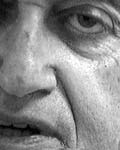
Fred Klein
THE FIRST POEM AROUND THE ORANGE TREE
THE SECOND POEM AROUND THE ORANGE TREE
THE Third POEM AROUND THE ORANGE TREE
I was born in 1922 in Pilsen, Bohemia (now the Czech Republic) into an upper middle-class family of highly assimilated German-speaking Jews. After the Nazis assumed power in neighboring Germany in 1933, my father Dr. Alfred Klein, a physician and German freemason, went into total denial of the Nazi threat even though he was fully informed of anti-Semitic activities in the Reich; he knew about concentration camps but underestimated the tragedy that would happen. On September 1, 1939, I witnessed my father being arrested by four Gestapos. Imprisoned in Buchenwald he was transported to Auschwitz where he died November 17th in 1942. I was deported with my mother and other family members to Theresienstadt in 1942 and from the"ghetto" to Auschwitz-Birkenau in 1944. I survived the death camp without a tattoo. I managed to be transferred to the little Friedland concentration camp in Silesia where I was liberated in May 1945 by the Red Army.
I returned to Pilsen. All 35 members of my extended family had perished. After the Communist coup in 1948, I fled to Argentina, where I worked as an illustrator, translator and general manager of a large construction company. I married in Buenos Aires in 1956 and have one daughter, Helen. In 1963 I immigrated with my family to the United States and settled in Los Angeles, California.
I have worked as an independent contractor, as translator, interpreter and commercial artist. I became head of the German Department, Berlitz North America, which is now the largest translation company in the world. Due to the Holocaust I lack formal education. An autodidact,I speak four languages in addition to my native German.
Please visit my website at:
<<< back to top
THE FIRST POEM AROUND THE ORANGE TREE
I stepped down in the dark of the night.
Suddenly, a sensuous smell surrounded and caressed me.
The old orange tree was covered with thousands of blossoms,
covered with tiny white stars, filling the darkened sky.
The fragrance almost overwhelmed me.
I inhaled the delicate scent and looked above me
and I saw the sky.
It surrounded the star-studded tree with countless tiny dots,
with distant stars.
A pale moon hung motionless on the side.
The world seemed to have come to an end
in silence.
A distant, monotonous murmur came from afar.
And I had hope.
I waited long in the dark of the night
until a faint pink color appeared in the East.
I waited as it grew bigger and rays of the rising sun began illuminating
the top of the tree.
The stars began slowly to fade away in the pale morning sky.
And first slowly then almost suddenly
a growing red glow announced the rising sun.
The sun appeared in glorious red.
A new cycle of life had begun
for trees grow, bloom, bear fruit and die as humans do.
And I had hope, hope again.
And I remembered.
The sun is the symbol of life. There can be no life without the sun.
The tree is the symbol of life and death.
Suns and stars die too.
And I remembered.
Fifty-six years ago, one night in October
my life was about to end.
My worrisome world was full of fire and smoke,
filled with a strange, sweetish smell.
There was no tree, no plant in Auschwitz,
in the inferno.
In Auschwitz, I stepped down in the dark of the night
and looked around me and above me.
The silence was strange.
Threatening.
Four crematories faced me
one in each direction,
spewing red rising flames high up into the gruesome, gray fumes.
There was no sky.
There were no stars.
There was no moon.
The moon had died and I had lost it all
lost hope.
This was the end.
One night in October I shivered for hours and hours,
standing outside the barracks alone
in the nightly,
nocturnal inferno
trying in vain to comprehend the incomprehensible.
The flames never died.
They were eternal.
The sky did not exist.
Slowly I had gotten used to the sickening, sweetish smell
of human bodies burned in a silent sacrifice
to an unknown God.
Is there a God?
Is life eternal?
Do flames redeem?
Are we entering a purgatory?
Are we being punished?
Shall our souls rise from the ashes?
Shall our ashes be scattered?
Is the world on fire?
I remember a father telling his son
"Breath deeply, my son," before entering the gas chamber.
I had questions and questions.
But no answers.
I did not feel fear or despair.
I was paralyzed, unable to grasp,
to understand
the inferno,
helpless, powerless,
standing, staring, waiting for the inevitable, unavoidable.
Waiting for death.
But the sky had been there all the time
hidden by the smoke
hidden by the horror of stark silence.
Suddenly, the sky opened
and I saw two tiny, distant stars
and I had hope.
I saw the stars for split seconds only.
I knew that stars die, too
and that the light which had reached me from far
may have been the last sign of life
of a star which had died light years ago.
Suddenly, the smoke covered the stars again.
The world became fire and flame and smoke and smell again.
But I could not forget the tiny stars.
I had hope
for I sensed there was still a world beyond the inferno.
Maybe there were more than two stars
and more human beings alive.
Maybe I would see more stars again,
more than two lonely stars
in the sky.
<<< back to top
THE SECOND POEM AROUND THE ORANGE TREE
Happy
I stepped down in the dark of the night,
standing motionless in the grass, lost in thoughts and sorrows.
For we had lost Happy, our companion and joy.
Sixteen years ago, she had adopted us.
A white-grey ball of hair jumped in the car.
Humans called her cockapoo, we named her Happy, our dog.
She lived with us, loved us, grew with us and got old with us.
Just like us.
Her eyes smiled.
She wiggled her tail, she begged and begged
and got excited when we returned, rewarding us with happiness.
We think she was not only Happy. She was happy with us.
She was part of the family. She talked.
She was sometimes moody and sad.
After many happy years she became very old.
She had a heart condition, a lung ailment,
arthritis and more.
She could not hear us any more and she began
to emit shriek sounds.
She died.
Is Happy in heaven now? Is there a heaven for humans?
If I cannot take Happy to heaven with me, I will not go.
I would not be happy without her.
We all have to die, dogs and humans.
Lost in thoughts I had not noticed the dawn.
The sun had risen and the stars had receded in the pale blue sky.
They were still there, but became invisible, hidden from human eyes.
And the sun continued to rise slowly as a red fireball in the sky. Suddenly I became aware of the orange tree.
It showed many dead branches
extending stark naked into the sky.
But the tree was green, full of new leaves
and branches, lush new green, the green of hope.
The tree had produced fruit, oranges, small and big ones
and flowers, flowers and flowers,
in December, in wintertime indeed.
Suddenly a sensuous smell surrounded and caressed me.
Covered with tiny white stars.
A tree for all seasons.
A tree of life.
Life is hope after the Holocaust.
There is always hope.
THE THIRD POEM AROUND THE ORANGE TREE
Two Thousand and One.
The earth has died.
Dark is the sky and far away and there is no moon
reflecting the red rays of the sun.
The sun has died.
The nuclear winter has come.
There is nothing left but destruction,
death and despair, everywhere.
But all that is imagination.
There is nothing left alive.
No trace.
No flower, no forest.
Not a single tree.
No houses. No homes.
No ocean, no sea.
No lakes, no rivers.
No running streams.
No cities.
No tiny flies.
No butterflies.
No bugs, no birds.
No animals.
Not a single human being.
Not even bones.
Only silent stones.
One hundred fifty and one year ago
the inferno started in Auschwitz
and it grew and grew
and encircled the earth,
went all over the world
until the flames finally died down,
the crematories collapsed
and the rest was silence.
There is no wind.
There is no sound.
Nothing at all.
But the star-studded sky still hangs over us
with two lonely shining stars
looking down to what was once the earth.
These stars have died millions of light years ago
and only their shining light
marks their place in the universe.
Their lonely light searches the earth down for a sign of hope, of life,
searches the gruesome, gray planet.
And someplace in a world of death and destruction
a tiny tree is born.
A survivor.
One day it will grow into a tall orange tree full of thousands of tiny
shining stars,
full of sensuous smell,
full of hundreds of golden oranges.
A survivor.
The last tree of live will live and die.
Will die.
Love moves the stars and the universe.
Love never dies.
Love is forever.
Two Thousand and One.
***
<<< back to top