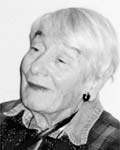
ELIZABETH EMANUEL
My Stories:
MEMORIES OF LONDON IN THE EARLY 1900S
THE BOMBING RAIDS ON LONDON, 1939-1945
I was born in the West End in London, England in 1911. My father was a barrister who helped to draw up the treaty of Marseilles after World War I. My mother was a sculptress and a suffragist. I lived through both of the wars in Britain. In 1959 I came to New York to work as an editor for children's books at Doubleday. I subsequently moved to Hollywood where I worked for Irwin Allen at 20th Century Fox.
I built up a research library and assisted in the making of films and TV programs such as: "20,000 Leagues Under The Sea," "The Towering Inferno," "Lost in Space," and "Land of the Giants." I wrote dialogue for "My Fair Lady." During this period, I also wrote two children's books: "Climbing Sun, Story of a Hopi Indian Boy" and "Baby Baboon." This was an exciting time in my life, which I remember with vivid and fond memories.
<<< back to top
I was born in London, England in 1911. I went to school in a small establishment kept by two elderly ladies, a Miss Roth and Miss Doreck. I was the middle child in a family of three with a sister 5 years older, and a brother 5 years younger. The spacing of our births was due to my mother's wish to take care of each of us separately-a nice idea, but I always regretted the difference of age between us, more with regard to my sister, who was classified with the adults than my brother whom I idolized and regarded as my special property.
I would tell him stories of whatever came into my mind, not realizing that he took everything I said as a literal fact, which led to disappointments on his side and regrets on mine. But too late, I am afraid, to make any adjustments possible!
When I reached my teens I went to Queens College in London and then at 15, I went to art school at my strong wish and against my mother's objections. My father, who had hoped that my general education would continue into college, had recently died, and she was too distressed at his loss to override my passionate protest that my future life lay in the world of art and music rather than (to me) that boring one of everyday life symbolized by the college covering a general education.
<<< back to top
MEMORIES OF LONDON IN THE EARLY 1900S
It seems to me, looking back in memory now, that London in the early 1900s was a much quieter city than it is today. At that time, I think not many private homeowners possessed their own cars. Only the well-off inhabitants could boast the luxury, so the noise of horse hooves rattling along the streets (many of which were still cobbled), led to them being liberally covered with rushes to soften the noise of the hooves, an annoyance to those who wished to sleep in the early hours of the day.
Well-off neighborhoods at that time often contained sealed-off sections of empty grassland across from their homes where they could walk their dogs. Privacy to these spots was maintained by issuing keys to the owners of these houses to the locked gates of these local parklands.
In the evenings, London streets were lit by a man holding a pole with which he could light the gas-lamps that were erected at the corner of each street. At about this time the street vendors arrived, displaying their wares. As the fall evenings became colder, I remember so well how much I enjoyed the packages of warm, skinned chestnuts sold in paper packages from a cart pushed along the street by the runner. This cart contained a large, open canister of nuts kept warm by a low-lit heater beneath them, from which the owner would shovel out a package of nuts for a few pennies a paper bag-full.
<<< back to top
When I was young enough to believe whatever I was told, I thought I had two daddies. First was my white daddy. I saw him every day so he was quite a familiar figure. He had breakfast with my older sister Marge, my younger brother, George, and I every morning. My father was a Barrister. (This is the English term for the person who takes on the arguing of the cases before the court.)
But I also believed I had another daddy. My other daddy didn't appear very often. But when he did show up, he was a very colorful person! He would arrive unexpectedly, saying in a strange, falsetto voice, "I am your black Daddy! I've come to visit my little white children!" He wore a fez on his head and a wide scarf of many colors and an array of necklaces around his neck.
Actually these necklaces belonged to my mother, but I didn't recognize them as being her belongings! He would sit down, putting a rather-reluctant me on his knee, and tell us about his country where grapes became as large as the size of melons over here. He would indicate their size by lifting his arms with elbows outstretched, using a falsetto voice and nodding his head as he spoke which made the description even more exciting.
And there were many other delicious fruits of all kinds that appear on everyone's table, as they were so plentiful that no household was without them. Children who lived there were never scolded, because they enjoyed their lives so much that they were always happy and never naughty. We definitely enjoyed his visits and regretted his departure.
So when white Daddy returned from work in the evening I would run up to him with great excitement, "Daddy, Daddy, my black daddy was here again!" He would reply, "OH! There now! He was here again, and I missed him another time! What a pity!" I believed in my two daddies for a number of eight years! I even told my teachers about them. I wonder what they made of it?
<<< back to top
THE BOMBING RAIDS ON LONDON, 1939-1945
The German bombers greatly exceeded the number of our English fighter planes which, at that time, were still at their peace-time strength‹but nevertheless fought back with the determination and spirit that fully deserved Winston Churchill's famous and oft-quoted phrase-"Never in the field of human conflict, has so much been owed by so many to so few."
London was the bomber's favorite target-as the Germans hoped this bombardment would cause such panic that the English would sue for peace even before their planned invasion of England took place. Those "dog fights," as we called them could be easily seen from the living room window of our London home and we watched them with breathtaking awareness!
Actually they had the opposite effect to what the Germans hoped. The English were furious, and even more determined never to give in! Londoners who had friends or relatives living in "the Shires" (provinces) were often welcomed to come there to stay, and accommodation was generously offered not only to relatives and friends but also even to strangers and for free to those who couldn't afford to pay.
Some of these people were living in already damaged homes but hadn't sufficient funds to pay for lodgings elsewhere, and were being cared for by associations such as the Red Cross. Quite a number of these homeless had taken refuge in the London train stations of the "Inner Circle" as it was named. The situation evoked a great deal of generosity and kindness in the general public.
Those who were able, offered to put up as many Londoners as they possibly could manage. It was a situation that opened up the eyes of some well-off families to the conditions of life led by their poorer neighbors. They discovered that there were London children who had never had such delightful experiences as eating a raw banana. In those days they were imported in small quantities for those who could afford them. There were also children who came from homes that were built before a bathroom was considered a natural part of every home.
They hugely enjoyed being rubbed down at bedtime in the living room in a tub of warm water in front of the friendly fireplace. They didn't think that a bathroom was anything like a good exchange for this warm sensation of togetherness. It was an exciting time to be young and living in London. King George Vth and Queen Mary stayed in Buckingham Palace all through the war. Each morning, after the nightly raids, they would turn up in the worst-hit spots, and walk around the ruins talking to the people living there, to make sure that they were being looked after. This paid off in an enormous swell of patriotism and enthusiasm. My mother and I had both become members of A.R.P. (AIR RAID PRECAUTIONS).
Her assigned job was as telephonist, on specified nights, at the post close to where we lived. Life seemed very dramatic and adventurous to me at the age of 28 when the bombing started. As I was strong and energetic with long legs useful for climbing roofs and going in and out of windows, I was welcomed into the A.R.P. and given a uniform to wear. I always slept with my uniform and a pair of shoes beside my bed.
My usual job was to patrol a specified section with a partner. We always worked in twos, one male and one female, making sure that no one was wandering around the streets and needed help during an air raid. Naturally a complete blackout was in effect for the complete city. My assigned buddy on these night patrols was an elderly Norwegian visitor to London who had wanted to see what it was like to be living in London in war time. He was a very pleasant companion-although unfortunately somewhat deaf, which would occasionally make him ask dubiously, "Was zat a bomb?" when the ground near us shook beneath our feet.
There were many people straying around already homeless. Some because they'd never had a home, or others who had been bombed out of their homes. A number of the latter had taken shelter in the underground train stations to serve as shelter for a few nights. These refugees had made themselves quite cozy with pin-ups on the walls, and cushions, blankets and signs to make it clear to any future lookers that this place had already been taken over.
A number of friendships had bloomed between one family and the one next to them. One night there was a very bad raid that did a lot of damage in London's East End, the poorest section of London.
We got quite a bit of damage in the area I lived also. This often happened since my home was within striking distance of one of the big London train terminals, Paddington Station, where troops embarked for their first point of destination, probably to Dover. A vivid recollection is the night bright with fires all over. A bomb completely smashed the house next to ours and tore off the whole back of our house. The blackout along with the dust and dirt raised by the bomb disintegrating made it impossible to see what had happened.
I had jumped out of bed, grabbed my uniform and shoes and flew down the stairs, barefoot amid the litter of broken glass, holding on to the banister for guidance. Fortunately, because it was so dark I couldn't see that the stairs had only the one side, the rest of the house had been completely demolished.
The bomb dropped just between our house and the one next door and shattered the front of the home of two elderly ladies. There was no way for them to escape to the safety of the street except by climbing over the division that separated our houses. This would have been no problem for me with my long legs and no fear of heights, but the elderly ladies could no longer move quickly and easily and if the view of the pavement below us was glimpsed on looking down, it would have seemed a daunting view to their eyes.
However they were both touchingly courageous and listened carefully to every move we told them and followed all our instructions carefully so that we were able to get them from their roof over to ours more easily than I had dreamed possible. These elderly souls bravely stepped over to the next roof, only a small space away, without looking down, and through our window.
But the most frightening discovery was yet to come. As the air began to clear from the dust of the explosion, I could see that where my sister, Marjorie's bedroom had been, there was now nothing but an empty space littered with bits and pieces of what had been there before.
A big tank, previously affixed to an outside wall of its occupants which held boiling water was now lying at an angle across the ground that was once a bedroom. By incredible good fortune it hadn¹t broken open but had come to rest at a rather unsteady angle. The force of the explosion had blown Marge from her bed.
By what can only be described as a miracle, she had been swept off her bed into the garden, and as we discovered by torchlight, was lying unconscious, in a fetal position, half-underneath the raised part of the tank, which had actually helped to protect her from other falling objects. If it had fallen flat on top of her it would, of course, have squashed her out of all recognition. Or if it had broken she would have been scalded to death.
The explosion had ripped off her nightdress and her whole body, from top to toe, was covered in grey dust, which made her appear more like a figure modeled, by a Greek sculptor than a living person. But, incredibly, she was without any worse injuries than cuts and bruises and some bone damage to one arm. (And we had always thought that she, in the ground floor room would be the safest of us all!)
The scout patrolling this street dashed to the house that was being used as a report centre for that section where my mother, known by everyone as "Kind Mummy," was the only telephonist. The report was immediately given to her, "Direct hit on N-4 Radnor Place." Kind Mummy looked up astonished and said, "You can't mean number Four. That's my house!"
An ambulance had already been called by Kind Mummy to take Marjorie to St. Mary's hospital that was only a few minutes away. It arrived amazingly soon considering all the potholes and bomb damage in the roads. I went with Marjorie in the ambulance, and as soon as I was sure that she was O.K. and would be well looked after, and the makeshift tourniquet that I had improvised would be replaced by the proper methods, I went to let Kind Mummy know the details of what had happened. I was able to tell her that Margie was already in the close-by St. Mary's Hospital and was receiving good attention, and apart from superficial damage to one arm had no serious injuries.
During this time, Kind Mummy had quickly received relays of prompt assurances of "ambulance on the way," "Three patients (names given) on the way to hospital," then names with reported injuries, and where they had been taken were all reported promptly. My last walk was to get back home, as I felt nervously depleted. Of course it was impossible to get a taxi, they were all busy cruising the streets, so I plodded on till I reached home and never felt more happy than I did that night.
One of our neighbours, who had been invited to stay with friends in the country, immediately phoned to offer us the use of her house, which we were very glad to accept. So we did pretty well and considered ourselves very lucky. One strange effect of the bomb that hit us was that (perhaps because it was so close) little fragments became imbedded in our skin.
We weren't able to enjoy the luxury of wallowing in a hot bath for two days after the bombing which had disrupted most people's flow of hot water to their houses. Then we discovered that the hotel connected with Paddington Station could provide hot baths. What a heavenly pleasure that provided!
<<< back to top