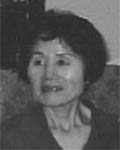
KAY CHUNG
My Stories:
A TYPHOON IN OSAKA, JAPAN-1935
I was born in Japan in 1932. My parents were Korean. After teaching two years in a high school I came to the U.S. for further study. I married and raised a family, then resumed teaching until my retirement in 1997. Now that all three grown children are on their own, I want to write my life story in Japanese after attending this life history writing class.
<<< back to top
A TYPHOON IN OSAKA, JAPAN-1935
It's raining now. It has been raining a lot of these days, but I hear the wind blowing hard now. The water runs on the window like someone has dumped a bucket full of water. While I am not getting wet inside the house, it's kind of fun to watch so much water running down the glass window. Sometimes the wind blows so hard that a chunk of water is pushed away like a big wave crashing, showing the sand at the bottom of the sea. It happens all of a sudden. I hear the wind hissing very loud.
This morning I get to see my two brothers leaving for school. I like their matching rain gear. I see them put on silver colored rain cloaks and shiny black boots. They both carry silver umbrellas. They also like their rain gear because they can come home dry. Even their leather knapsacks are dry under their waterproof rain cloaks.
When they come home I look forward to seeing if their boots are shiny or muddy. This morning as I see them off, the rain is still pouring. It feels gloomy.
On rainy days like this I can't go out and play with my playmate, Sachiko. Sachiko and I like the same dish: a warm piece of toast dipped in creamy sweet milk. When I see my mommy and daddy sitting at the table, my gloomy feeling is gone. I feel warm and cozy. I forget the wind and rain outside. I can now have my favorite breakfast with my mommy and daddy.
I wish Sachiko could join with me. My special milk tastes so creamy and sweet. I finish two pieces of warm toast in a jiffy. Before Daddy finishes his coffee Mommy gets up to get something. Next Daddy gets up and takes my hand to put on my raincoat. I hear the wind hissing again. Scary!
Daddy and I are outside getting wet but he can't open the umbrella. Mommy tries hard to close the front door. Daddy now helps her close the door. On Daddy's back I see dogs, pigs, bikes, cats broken doors and many other things floating on the river as we walk along it.
Many people are out on the street going somewhere. The rain doesn't stop. The wind blows from the front, back and all over. Roof tiles, billboards, poles and other things are flying all over. I feel all of a sudden warm, cozy and secure on my daddy's back, covered with his big raincoat over mine. Mommy's walking right by Daddy, covering us with the umbrella. I feel so secure knowing Mommy and Daddy are so close by.
Flying objects and floating things do not worry me. I even feel happy because Daddy and Mommy will stop anything coming against us. I hear the wind hiss, children cry, and grown-ups yell and scattered things on the streets rattle, but nothing upsets me. We are all heading toward the church. We will see my brothers there. I feel so cozy in the rain and I feel like sleeping on my daddy's back. When I see my two brothers in the church I feel so secure that I go back to sleep again.
<<< back to top
If you look at a map made in Japan, Japan is the center of the map. Osaka, the second biggest city, is located in the central part of the main island, Honshu, partly bordered by the Osaka Bay that connects the Pacific Ocean and the Japan Inland Sea.
In 1938 the population of Osaka was about two million. Our family lived downtown. From our house we could see the Ikoma Mountain range that lies between Osaka and a neighboring prefecture, Nara to the east.
One spring day, I was at my oldest cousin's house. I felt warm and comfortable in bed when wakened. I saw her children getting dressed and felt some excitement in the air. "Get up and get dressed. The baby was born this morning," my cousin said.
I was so excited that I didn't even ask if it was a girl or a boy. I jumped up from bed. The sun was up and shone all over the house. I had been the baby of my family for a long time, although my younger sister had passed away, suffering from pneumonia before she was one year old.
Before long I was going to be a first grader. In Japan the new school year began in April, so I could go to a real school and not kindergarten where children move about and do whatever they want.
I really enjoyed being the baby of the family, for my parents always introduced me as, "This is our baby." wherever they went and to whomever they saw.
Then I got a chance to say greetings in Korean. A few Korean parents in Japan taught Korean to their children. I could always expect their praise for my Korean and politeness. I don't remember how we went to our house or if I thought of being no longer "the baby" of the family.
My cousin usually brought all her children, three or four, whenever she visited with us, but that morning she took me alone. As we entered my mother's room I heard the midwife say, "It would have been nice if the baby was born yesterday. Then she would have her birthday on Girls' Day."
I saw Daddy and the midwife beside my mother but I looked at the baby first. "What a pretty baby, with fair skin and big eyes. Now I have a sister," I said to myself. I had two older brothers but never a sister.
Later, coming home from school, I often saw the doctor's rickshaw in front of our house. Before World War Two in Japan, doctors made house calls in the rickshaw (a covered wagon pulled by a man).
June was a very sensitive baby and became sick easily. Before opening the door, my heart would ache because I expected to see the baby's face blushed with fever. She had beautiful round eyes but they too got flared.
"Mommy, what does June have in her ears?" "Oh, the doctor says she needs ear plugs because she may be frightened by the noises like the train whistles we hear sometimes. She is a very, very sensitive baby. We have to watch for anything that may cause her fever."
By the time June was three I would take her with me to play with my friends. None of my friends had a younger sister or brother, so they all welcomed her. June seemed proud in her dresses that Mommy put on her and minded me well wherever we went.
We picked violets, clovers and dandelions in spring and wild chrysanthemums in fall to make a garland. With a garland on her head, June looked like a princess in a picture book. When alone she liked to play with dolls, especially a French doll with a sky blue flared dress. She was fascinated by its blue eyes that opened when standing and closed when lying down. I admired her pretty doll's eyes but I liked June's round dark brown eyes better. They were different. They conveyed something mysterious with a glimpse of sadness.
<<< back to top
I never know what time my mother gets up. Every morning I get up and go downstairs. I smell the breakfast that my mom prepared. I join my two brothers at the table. As I leave for school, I go outside and feel the chilly air in the early spring morning.
The cool air gets all around my face, especially my ears, but inside my mouth I still feel the warmth of the rice, taste the fluffy omelet and I can even smell toasted seaweed with sesame oil and miso soup. I don't know how many mothers can make such a fluffy omelet as she does. I even like onions if those are in her omelet.
Here in our big city (2 million) of Osaka, Japan, we live in a quiet residential area. From my house to school, I first walk left one block to the end of the street, then turn to the right to walk three blocks to a big street where the big city buses run. I like one side of the three blocks.
It is a small riverbank where lush trees of many kinds and blooming bushes make beautiful reflections on the surface of the little river. When it's windy or rains hard my mother walks with me to get across the big street. Along the riverbank, we like to stop and watch whirlpools of all shapes and sizes.
On those mornings even the reflections of the trees and flowers change according to the direction and strength of the rain and wind. Those days I enjoy Mom's company but after I cross the street I feel lonesome because then she turns around to head home.
This morning after crossing the street, I walk on the unpaved road along a field, and all of a sudden I imagine Mom's smiling face in front of my eyes. I feel an unusual longing for her. I look up ahead toward the mountains and the sky. It is hazy. I know the spring is here.
In fall I like to look up the clear blue sky, but I usually feel kind of lonesome, contrary to the feeling I usually have in spring. This morning I feel as if I am in the fall season. With out any reason I've come to feel this way. I wonder: Can Mom make breakfast for me until I grow up? Can she be home every day when I come home from school? She is quiet, graceful, slender, kind to others and respected by many.
Often I see a lady or a group of ladies in the living room when I come home from school. They come for my mother's advice and prayers for them. She is such a diligent lady, working all day. The only time I see her sit down is when she knits, or sews at the sewing machine. She never takes a nap.
Lately, however, I sometimes see her lying down in bed. "Are you home already? You must like a snack." Smiling, she gets up. A few times she frowns as she raises herself. Why does she lie down in the daytime? Is she sick? But she doesn¹t tell me she is sick, I wonder...
Last year she went to Korea with Father. Why did she go? She doesn't go to Korea often. Besides, people don't travel now, fearing war may breakout. One Sunday while she was away, a church schoolteacher asked me, "When is your mother coming back?" "In two weeks." "Do you know why she went to Korea? Oh, she wanted to have a baby in Korea," she answered herself. I knew that she did not go to Korea to have a baby, but I still didn't know why she had to go while we were in school. By the time I hear the school dismissal bell I feel like jumping out of my seat. I skip to the main gate across the school playground. I can go home to see Mom!
My homeroom friends stop off to buy snacks or school supplies at stores across from the main gate of the school, but I want to go home just as fast as I can so that I can have a snack my mom prepares for me. I first start walking with a few girls going in the same direction. On the way to the big street I skip, run and walk fast. By the time I cross the big street I am the first one to run. I am happy to get home.
Then, as I near the last turn to the street where my house is, I feel afraid to see my mom in bed. It's after a hospital stay but she still doesn't get well. I hope and pray that she is always home to wait for me from school. How could I go home if she wasn't there? On the last stretch toward my house I quickly pray, "Dear God, please keep my mom there always at home when I come home, even if she can't get up from bed. I want to see her every day even if she is sick for the rest of my life."
While thinking I cannot live even one day without my mom, my warm tears run down my face. The wooden framed glass door rattles as I slide it open. "Is that Keiju?" "Yes, I'm home, but I have to wash my hands first. They got dirty coming through the field." I don't want Mom to know that I cried on the way home.
One day Dad tells us that the government of the city of Osaka decided to decentralize all elementary school children from the central district of the city to make it possible to escape possible air raids. Fortunately we live in the outskirts, but he says he'll feel safer if we move away from the city.
Soon we are living in the beautiful suburban countryside where we go for vacation in the summer. In the fresh air with all of the fresh vegetables and fruits we hear no clatter of the city, yet I feel so depressed. Not because Dad is away, out of country on business, or because my brothers are in the dormitory away from home, but my mother's condition gets worse.
By now I know she is suffering from liver cancer. Somehow I have learned that it is intolerably painful. It is so difficult to understand why my mother, the best mother may not live long. My heart really aches hearing her sobbing. It's not because of her pain but because of the young children she is leaving behind.
She kindly asks me to take my baby sister out in the front yard for sunbathing. As we go out I sense Mom trying to suppress her sobbing. I wish I could tell her not to worry about us, but I don't want her to know I hear her sobbing. I don't know why Mom is not in hospital but this morning Dad tells me she is going to hospital.
That hospital is the only one that will accept a patient as seriously ill as she. During World War II there are no available housekeepers nor hospital attendants, so I am told to stay by her bedside while Dad is gone. On her way to hospital she cries saying, "I will never be able to come back."
June is taken to my cousin, and my baby sister to my aunt. Most of the time I stay with my mom. I am sorry I can do nothing for her. She quietly calls me to her bedside occasionally to tell me how sorry she is to be leaving us behind. "One thing, Keiju, I would like you to hold to, is faith in God. The rest you will get from your father who will provide you with the best education, etc."
I make up my mind to follow her instructions, and start praying, "Please take her to the place where there is no pain." At her death we all pray ardently that God will take her to Heaven where peace and happiness are fulfilled. I utter my last prayer for her to have no more pain.
<<< back to top
The old capital city of Kyoto is situated to the north of Osaka and one can reach the city of Kobe by the train going west. The remote village where my family moved to avoid air raids is in the direction of northwest, between Kyoto and Kobe, a one-hour train ride into a remote area.
If one could forget about recent frequent air raids, traveling along this rail track would be very pleasant. I like the spot where the river widens and a series of cascades fill the width and depth of the river. Nowadays, it would be a typical viewpoint for motorists to stop at.
In 1944, when my oldest brother was living in a college dorm, my other brother, Dalborn was living in a boarding house in order to attend his school. I was living with my two younger sisters now that mother had passed away and my father was often away on business trips to China.
One day unexpectedly, Dalborn returned home to live and now had to commute to school over a 2 hour course one way. I tried to get up early to prepare breakfast for him and pack a lunch for him to take. He stopped me immediately, and suggested I pack his lunch the night before from leftovers.
He did not want me to get up so early for him, although he was willing to commute, spending over five hours just for me. In summer it was hot and humid all through the night, and with no refrigeration, most cooked food got spoiled by the next morning.
Whether he ate the spoiled food, or went hungry nobody knew. It was a tough commuting route. From the train station to the house it took him at least one hour by bicycle. There were two hills that he had to walk up, while pushing his bike. It was pitch dark there because of the thick surrounding woods. He sang his favorite hymns. One frequently: "Abide with me first falls the eventide. The darkness deepens, Lord with me abide; When other helpers fall, and comforts flee, Help of the helpless, O abide with me."
Contrary to what he would have liked, that is, hot dinner waiting to satisfy his hunger, he asked me to stay at our cousin's and to wait for him every evening so that he could pick us on his way home and help me cook dinner.
He did not fail to tell me how he enjoyed the young sprouting leaves and twigs hanging and plum and cherry blossoms falling overhead as he walked up the hills. Everything was scarce during the war.
After he finished his homework as I was going to bed, I often saw him bringing in his bike to repair a puncture without having a new tire to replace any worn out tires. Dalborn had been selected to enter a special college for training communication specialists. At the age of 16, he passed the English and Math exam at the top of his class and then became the communication officer of a commercial ship for transporting military goods.
Mother would have prepared a little party for him, but he quietly left on the morning of his departure, saying, "Take good care of yourselves. Don't do much. When I return, I will have a long break to help you."
We lived in the postmaster's house on the hill. He and the village chief had the two of the best houses in the village. He was still living in the official residence of the postmaster; therefore, the entire house was rented to us. The house was much, much too big for three little girls, but he was there every day to work around the house, especially caring for the beautiful traditional Japanese garden with a stream running throughout.
As soon as had Dalborn left, I constantly worried, "When is the war ever going to end?" This gloomy thought came over me, remembering how the elementary school teachers pounded the idea into us, that "All of us have to be prepared to live through this long-lasting war no matter what, the young and old, the haves and the have-nots, until the last drop of blood."
After a week, a long-awaited letter arrived, "I hope Father will be home soon. After a week of strenuous military training, we are on the way to Chintau, China transporting military supplies. We are leaving from the Japan Inland Sea. This is the virgin voyage for this ship. I can tell you all this because the MP officer censor and I have become good friends and he trusts me..."
Dalborn wrote everyday. In his second letter, he wrote, "I'm homesick. I can see before my eyes all the cherry blossoms in full bloom along the river we swam every day last summer. I feel sorry for your heavy responsibility. I always pray for you and I will help you when I return, so don't do much, Keiju. Don't forget to take care of yourself," he wrote.
The following letter read, "Keiju, we get plenty of rations of all kinds. I have already started to save candies and cookies. Cakes of soap remind me of your soft soap. These will help your washing. We will enjoy sharing condensed milk that we both like. I am looking forward to giving you a special gift, an unwrapped fluffy wool blanket. I haven't been able to give you any gift for some time. I have plenty of covers to keep me warm here, so this new blanket will really keep you warm."
Just about one week before we were to have Dalborn back his daily letters stopped. I at first thought it might be because the ship was approaching China from Japan, and the mail delivery might not work the same way. When my oldest brother came home that weekend, he was also puzzled about not hearing from Dalborn.
We anxiously waited until the day he was expected, but there was no word as to his return. As my oldest brother returned to his dorm, he said to wait another week. This waiting period for me felt unusually long. Finally, my oldest brother came home with a very depressed look. "Keiju, I went to the office of that ship company, and asked about the ship Dalborn was on.
When I heard someone say loudly, "Isn¹t it the ship that sank last week?" my heart sank just like that ship. I later talked with the captain of the ship, who happened to be there. He had lost one of his legs, but all the officers survived because they were all on the top deck.
He explained, "After I jumped off the ship I saw the plane dropping the second bomb aimed at the communication operating room where all the secret codes were kept," the captain told my brother.
My brother, Dalborn was only seventeen, but he was responsible for protecting the secret code. After all the officers were ready to leave at the first bomb attack, Dalborn was the only one seen returning to his office. It was presumed that he went in to get the secret codes that he was responsible for sinking overboard, before he could leave the ship.
For many, many years I wanted to hear that Dalborn was living on one of the islands of the Pacific Ocean as some soldiers had done, surviving through air raids.
<<< back to top
My cousin's name is Ran. The Ran is Asian orchid. These orchids are dainty, fragrant and stylishly slim. One might expect that her name reflects her appearance. In Osaka, Japan where she lives, the majority of the people still depend on public transportation.
Ran is 17 years my senior but she frequently uses the public transportation when her children are unable to drive her. Just as soon as she gets on a bus or train she starts conversations with the people around her, regardless of the age of the other party. She is always able to find a topic to make them respond: "That box must be too heavy to hold while you're standing." "Not really, but thank you kindly," the passenger responds.
Meanwhile, a seated passenger gets up to yield a seat to Ran because she is elderly. She says, "Oh thank you kindly," to the seated passenger. "You sit down. I'm alright," she insists to the standing passenger with the box.
In Japan one hardly observes the young yielding a seat to the old or the weak anymore. When she is seated, she strikes up a conversation with the next passenger or the one in front, "How fragrant and beautiful are the flowers you have! Are you taking them to your friend? Oh, too many for one person. Are you in the flower business?"
Occasionally she is completely ignored, but she does not get defeated. "You must be hard of hearing," she mutters. At her age of 87 she still rides her bike in her neighborhood.
Whenever the grocery store owner phones her to say, "We have some mangos that came in from Australia," or "Fresh fillets of yellow tail or salmon have just been air flown," she takes her bike out to get to the store‹against her children's imploring request not to ride it.
Her wealthy daughter fills her refrigerator religiously with all sorts of delicacies, but immediately two-thirds are shared with lonely neighbors or the sick. Whenever she goes to church, even for quiet prayer meetings, the congregation notices her presence because of her cheerful, not so quiet greetings. She was retired from the board over twenty years ago, but she still wishes to be present at every meeting. Although she has no vote, she is still allowed to attend meetings. Neither the board nor the minister is able to reject her attendance at any meeting because of her big sums she donates. With the financial support by her daughter who blindly trusts her mother's righteousness, my cousin frequently overpowers the consensus of the board.
Consequently, her son's family quietly left the church. Her son could not persuade her to refrain from unjustifiable insistence on every matter, administrative or spiritual. Ran grew up as an orphan. My maternal grandmother raised her until she was eight years old, then she was adopted by our aunt who promised to educate her in her private school in exchange for Ran's babysitting service for part of a day.
Contrary to every family member's expectation, this college-graduate aunt did not live up to her promise as far as Ran's education was concerned. Fortunately, Ran was unusually bright and motivated enough to self-teach. A few think that she has no formal education.
However, her unfortunate marriage led her to a miserable married life. While womanizing, her husband would blame her: "If you were educated enough, if you are graceful and quiet, if you don't walk like a duck, etc." "I wish I resembled your mother a little," she would mutter toward me, as she went about doing her household chores.
She raised three older sons and three younger daughters, very close in their ages, single handedly. Whatever she did; knitting, cooking, cleaning, and all were done expeditiously. I always liked how she worked so efficiently, and said to myself, "Where is her husband going all dressed neatly and all by himself?"
Ran would bring all her children by herself to visit us and never forgot to bring a basket full of home-made cakes and sweets that I liked better than the store-bought kind. During World War II, her husband was out of work, and did not try to look for any job. Instead, he played chess all the time with the retired farmers in the village away from Osaka, drinking with the hard-earned money that his wife had just enough of for living. Throughout the war and the period after the war until her children grew up, she had to make a living by carrying heavy rice on her back.
The special crop of rice that the village produced was in demand by certain sushi restaurants in Osaka. She carried the sushi rice to selected restaurants and earned fairly good money only by making more trips than other rice carriers. She worked from dawn to midnight. The more she carried, the more income she brought in, but the heavy weight of rice on her back eventually caused her to have severe arthritis. Her husband knew of her sickness before his death in 1970. Since 1964, the Olympics and the Vietnam War have benefited Japan economically and the people in general have become better off.
Ran's children are no exception. They are all well to do. They all appreciate and respect their mother and support and treat her accordingly. With her well-groomed white hair, Ran looks graceful. Her dainty smile invites people around her to smile. Her good deeds are carried out stylishly. And her mature way of dealing with terminal lymphoma is spiritually fragrant, like the meaning of her name, Asian Orchid.
<<< back to top